A practical guide of TWL vs WBGT, the two most important heat stress indices in occupational safety — what each one measures, where each one is mandated, and how to choose the right tool for high-heat worksites.
The Short Answer
WBGT (Wet Bulb Globe Temperature) tells you how hot the environment is. It is an environmental index: a single number describing the combined heat load of temperature, humidity, radiant heat, and (to a limited degree) air movement. It is the global regulatory baseline — written into OSHA guidance, ISO 7243, ACGIH, military doctrine, and national codes such as Singapore’s MOM framework.
TWL (Thermal Work Limit) tells you how much work a person can safely do in that environment. It is a rational, limiting index: instead of reporting how hot it is, it calculates the maximum sustainable work rate (in watts per square meter) at which an acclimatized worker can keep their core temperature and sweat rate inside safe limits.
In one line: WBGT measures the environment; TWL measures what the environment will let you do. They answer different questions, and on a high-heat industrial site you often want both.
What is WBGT?
Wet Bulb Globe Temperature was developed in the 1950s for the U.S. military to curb heat casualties during training, and has since become the most widely adopted heat stress index in the world. It is standardized internationally under ISO 7243.
WBGT combines three separate temperature measurements:
- Natural wet bulb temperature (Tnwb) — captures the cooling effect of evaporation, and therefore humidity. The more humid the air, the less sweat evaporates, the higher this reading.
- Globe temperature (Tg) — measured inside a black globe, captures radiant heat from the sun and hot surfaces.
- Dry bulb / air temperature (Ta) — ordinary ambient air temperature.
These are weighted into a single index. Outdoors, in direct sun:
WBGT = 0.7 × Tnwb + 0.2 × Tg + 0.1 × Ta
Indoors or with no solar load, the dry bulb term is dropped and the formula becomes:
WBGT = 0.7 × Tnwb + 0.3 × Tg
The dominant 0.7 weighting on the wet bulb term is deliberate: in most workplaces, humidity is the single biggest driver of heat strain, because it governs whether the body’s main cooling mechanism — sweat evaporation — can actually work.
How WBGT is used in practice: you measure the WBGT value, then look up a reference table that adjusts the safe threshold according to the worker’s metabolic workload (light, moderate, heavy) and clothing. The output is a work/rest schedule — for example, “50% work, 50% rest per hour” — at a given WBGT.
WBGT’s strengths:
- It is simple, widely accessible, and universally understood.
- It is the index named in regulation almost everywhere, which makes it the language of compliance documentation, audits, and permits.
- Decades of reference data exist linking WBGT values to safe work/rest ratios.
WBGT’s limitations:
- It is only weakly sensitive to wind. Air movement dramatically changes how much heat a body can shed, but WBGT captures only part of that effect through the wet bulb. On a breezy site, WBGT can overstate the real risk; in still air it can understate it.
- It does not account for clothing directly — you adjust for it manually via correction factors, which is error-prone in the field.
- It gives you an environmental number, not a work rate. The translation from “WBGT = 30 °C” to “this crew can safely keep working” still depends on a table and a judgement call.
What is TWL (Thermal Work Limit)?
The Thermal Work Limit was developed by Dr. Graham Bates and Dr. Derrick Brake, originally for the deep, hot underground mines of Australia, where WBGT-based rules were proving too blunt to manage a self-paced, acclimatized workforce safely and productively.
TWL is a rational heat stress index. Rather than describing the environment, it models the heat balance of the human body and solves for a limit. It takes five environmental inputs:
- Dry bulb temperature
- Wet bulb temperature (humidity)
- Globe temperature (radiant heat)
- Wind speed / air velocity
- Atmospheric pressure
…together with a clothing factor, and computes the maximum sustainable metabolic rate — expressed in W/m² — that a healthy, acclimatised, hydrated worker can maintain without their deep body temperature exceeding ~38.2 °C or their required sweat rate exceeding what is sustainable.
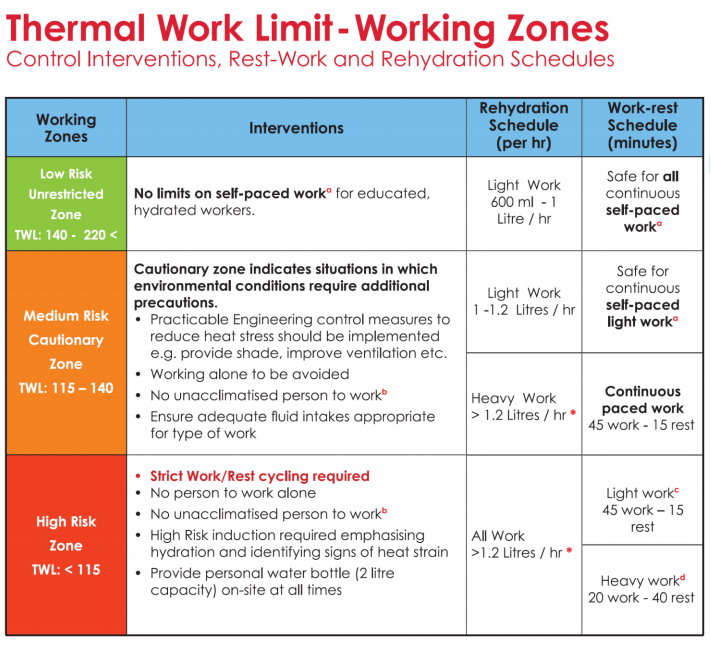
That output is the key difference. A TWL value is actionable on its own: a high TWL means unrestricted work is safe; as conditions worsen, the limit falls, and at defined thresholds the protocol moves to acclimatization zones, mandatory rest, or stop-work — without needing to cross-reference a separate metabolic table.
TWL’s strengths:
- It explicitly incorporates wind speed, which WBGT largely ignores. In open industrial environments — construction sites, ports, oil & gas facilities, desert worksites — air movement is a first-order variable, and TWL responds to it correctly.
- It accounts for clothing in the calculation rather than as an afterthought.
- Its output is a work-rate limit, which maps directly to operational decisions (how hard the crew can work, for how long) rather than requiring a lookup table.
- It was purpose-built for acclimatised, self-paced workforces in extreme heat, which describes much of the Middle East, Australian mining, and Gulf construction sectors precisely.
TWL’s limitations:
- It assumes an acclimatised, healthy, hydrated worker. For unacclimatised crews, new starters, or workers with medical risk factors, its limits are less conservative and must be applied with extra caution.
- It is less embedded in regulation than WBGT. Few national codes name TWL explicitly, so it usually functions as an operational management tool layered on top of WBGT-based compliance, not as a replacement for it.
- It requires measuring wind speed accurately, which means a more capable instrument than a basic WBGT meter.
The core difference, in one comparison
| WBGT | TWL (Thermal Work Limit) | |
| Type of index | Empirical, environmental | Rational, limiting (physiological model) |
| Question it answers | How hot is the environment? | How much work can a person safely do here? |
| Output | A temperature index (°C), read against a work/rest table | A sustainable work rate (W/m²), a direct decision |
| Inputs | Wet bulb, globe, dry bulb temperatures | Wet bulb, globe, dry bulb + wind speed + pressure + clothing |
| Wind sensitivity | Weak | Strong — explicitly modeled |
| Clothing | Manual correction factor | Built into the calculation |
| Assumed worker | General | Acclimatized, healthy, self-paced |
| Origin | U.S. military, 1950s | Bates & Brake, Australian mining |
| Regulatory status | Global baseline (ISO 7243, OSHA, ACGIH, MOM) | Operational tool; rarely mandated by name |
| Best at | Compliance, documentation, universal benchmarking | Managing productivity and safety in extreme, windy, acclimatized settings |
Which one should you use?
This is not a contest with a single winner. The right answer depends on what you are trying to do.
Use WBGT when:
- You need to satisfy a regulation, audit, or permit that names WBGT (which is most of them).
- Your environment is relatively standard and the workforce mixed or unacclimatised.
- You want a simple, defensible, universally recognised number for documentation.
Reach for TWL when:
- You operate in extreme, sustained heat where WBGT-based work/rest ratios can be either overly conservative, limiting productivity, or too broad to capture real risk.
- Wind is a significant and variable factor — open construction sites, ports, offshore, desert oil & gas — and you need the index to respond to it.
- You manage an acclimatised, self-paced workforce and want to maximise safe working time rather than impose a one-size-fits-all rest schedule.
- You want a limit that translates directly into an operational decision without a metabolic lookup table.
The practical reality for most high-heat sites is “both.” WBGT is your compliance floor — the number that goes in the audit file. TWL is your operational ceiling — the tool that lets you manage real work, in real wind, with a real acclimatised crew, without either endangering people or stopping work unnecessarily. A monitor that reports both gives a safety manager the compliance number and the operational answer from a single instrument.
The compliance angle: WBGT as floor, TWL as edge
Most heat stress regulations — OSHA’s heat guidance in the U.S., ISO 7243 internationally, and Singapore’s Ministry of Manpower (MOM) heat stress management requirements — are built around WBGT. So any credible heat safety programme has to speak WBGT to pass an audit.
But meeting the WBGT floor and managing a workforce in 45 °C Gulf summer heat are two different problems. This is where TWL earns its place: it is the index that distinguishes a programme that merely documents compliance from one that actively optimises the trade-off between worker safety and lost productivity.
The strongest position for an operator in an extreme-heat market is therefore: meet the mandated WBGT requirement, and go further with TWL for operational heat management.
A real-world example: Heat illness reduction at the Emirates Group
The difference is not academic. After deploying TWL-based heat stress monitoring, the Emirates Group recorded a 60% reduction in heat illness cases across the implementation — in one of the most demanding hot-climate working environments in the world.

The mechanism is exactly the distinction described above: a WBGT reading would have told supervisors how hot the apron and ground-handling areas were. The TWL-based approach told them how much work the crews could actually sustain given the heat, humidity, radiant load, and the wind — turning an environmental measurement into a live operational limit that crews and supervisors could act on shift by shift.
Frequently Asked Questions
What is the difference between TWL and WBGT?
WBGT (Wet Bulb Globe Temperature) measures how hot the environment is, as a single index combining temperature, humidity, and radiant heat. TWL (Thermal Work Limit) measures how much work a person can safely do in that environment, calculating the maximum sustainable work rate in watts per square metre for an acclimatised worker. In short: WBGT measures the environment; TWL measures what the environment will let you do. They answer different questions, and high-heat worksites often use both.
What is WBGT (Wet Bulb Globe Temperature)?
WBGT is an environmental heat stress index developed for the U.S. military in the 1950s and standardized internationally under ISO 7243. It combines natural wet bulb temperature (humidity), globe temperature (radiant heat), and dry bulb temperature (air temperature) into one value. Outdoors in direct sun the formula is WBGT = 0.7 × natural wet bulb + 0.2 × globe + 0.1 × dry bulb. It is the global regulatory baseline used in OSHA guidance, ACGIH, and national codes such as Singapore’s MOM framework.
What is TWL (Thermal Work Limit)?
The Thermal Work Limit is a rational heat stress index developed by Dr Graham Bates and Dr Derrick Brake for the deep, hot mines of Western Australia. Rather than describing how hot the environment is, it models the heat balance of the human body and calculates the maximum sustainable work rate (in W/m²) that a healthy, acclimatised, hydrated worker can maintain safely. It takes five inputs — dry bulb, wet bulb and globe temperatures plus wind speed and atmospheric pressure — together with a clothing factor, and unlike WBGT it explicitly accounts for wind.
Is TWL better than WBGT?
Not “better” — different. TWL is more informative for managing acclimatised workforces in extreme, windy heat because it accounts for wind and outputs a work-rate limit. WBGT is the regulatory baseline and is simpler and more universally recognised. Most robust programmes use both: WBGT for compliance, TWL for operational management.
Does a TWL monitor also measure WBGT?
It can, and the best ones do. Because TWL already measures wet bulb, globe, and dry bulb temperatures, a well-designed instrument can report WBGT from the same sensors — giving you the compliance number and the operational limit together. Scarlet’s TWL-1S and TWL-1SV are built around this principle.
Why doesn’t WBGT account for wind?
WBGT captures a limited wind effect through the natural wet bulb measurement, but it was never designed as a wind-sensitive index. In environments where air velocity varies a lot, this is its main blind spot — and the main reason TWL was developed.
Is WBGT required by law?
In most jurisdictions, the heat stress standard is expressed in WBGT terms (ISO 7243 internationally; OSHA guidance in the U.S.; MOM requirements in Singapore, among others). TWL is rarely mandated by name, so it typically supplements WBGT-based compliance rather than replacing it.
What is the safe TWL threshold?
TWL is reported as a sustainable work rate in W/m², with defined bands that trigger different protocols (unrestricted work, acclimatization zone, buffer zone, withdrawal). Specific thresholds depend on the standard and the workforce; they assume a healthy, acclimatized, hydrated worker and should be applied more conservatively for unacclimatized or at-risk individuals.
Which heat stress index should I use for construction or oil and gas worksites?
Use WBGT to satisfy regulations, audits, or permits and for standard or unacclimatized workforces. Reach for TWL in extreme sustained heat where wind is a significant and variable factor — open construction sites, ports, offshore, and desert oil & gas — and where you manage an acclimatized, self-paced workforce and want to maximize safe working time. For most high-heat sites the practical answer is both: WBGT as the compliance floor and TWL as the operational ceiling, ideally from a single monitor that reports both.
Conclusion
WBGT and TWL are not rivals; they are two layers of the same heat safety strategy. WBGT is the language of compliance — universal, simple, and mandated. TWL is the language of operational control — wind-aware, work-rate-based, and built for the extreme environments where getting heat management right has the highest stakes.
For a standard indoor or moderate worksite, WBGT alone is often enough. For high-heat, high-wind, acclimatised-workforce environments — Gulf construction, ports, oil & gas, mining — a TWL-capable monitor that also reports WBGT gives a safety manager everything they need: the number for the auditor, and the limit for the crew.
Scarlet Tech designs heat stress monitoring instruments built around the Thermal Work Limit, with WBGT reporting from the same sensor set — including the TWL-1S portable heat stress meter and the TWL-1SV heat stress weather station. Learn more about our heat and weather monitoring solutions.