As occupational heat exposure becomes an increasingly important concern for industries operating in hot environments, choosing the right method to assess heat stress is critical.
Wet Bulb Globe Temperature (WBGT) remains one of the world’s most widely recognized heat stress indices. Thermal Work Limit (TWL), however, takes a different approach: instead of primarily expressing the severity of the environment, TWL estimates the maximum sustainable metabolic work rate under the measured environmental conditions.
A peer-reviewed study published in Annals of Work Exposures and Health in 2022 provides an important independent evaluation of how well TWL distinguishes between sustainable and unsustainable heat stress exposures. [1]
What Is Thermal Work Limit?
Thermal Work Limit is a heat-balance-based method designed to estimate the maximum metabolic rate at which a worker can maintain thermal equilibrium under a given combination of environmental conditions, clothing and acclimatization.
In practical terms, TWL converts environmental measurements into something directly relevant to work planning:
How much physical work can be sustained under the current conditions?
This is an important distinction from traditional environmental indices. Workplace heat stress depends not only on temperature, but also on humidity, radiant heat, air movement, clothing and the amount of metabolic heat generated by physical work.
TWL brings these factors together to estimate a limiting sustainable work rate, expressed in watts per square metre (W/m²).
What Did the 2022 Study Examine?
Researchers from the University of South Florida analyzed an existing database of controlled progressive heat-stress trials involving 29 heat-acclimatized participants.
The trials included different combinations of:
- metabolic work rates,
- levels of relative humidity, and
- clothing ensembles, ranging from conventional woven work clothing to particle-, water- and vapor-barrier garments.
During progressive heat-stress testing, researchers identified the transition between a compensable exposure, where the body could maintain thermal equilibrium, and an uncompensable exposure, where core temperature continued to rise.
The calculated TWL was then compared with the actual metabolic workload at each exposure.
This allowed the researchers to ask a straightforward question:
Does TWL successfully identify conditions in which the worker’s metabolic workload exceeds a sustainable thermal limit?
TWL Showed High Sensitivity for Uncompensable Heat Stress
One of the most significant findings was TWL’s high sensitivity.
Across the four clothing categories examined, TWL showed approximately 95–97% sensitivity in identifying uncompensable heat stress exposures.
In occupational health terms, high sensitivity is valuable because it means that exposures experimentally identified as thermally unsustainable were very likely to be flagged as exceeding the TWL limit.
The researchers concluded that TWL follows a public-health-oriented approach characterized by high sensitivity at the cost of relatively low specificity.
This distinction is important. The result should not be described as “95–97% accuracy.” Sensitivity specifically refers to TWL’s ability to identify the uncompensable exposures in this experimental dataset.
A TWL Limit Is Not a Zero-Risk Boundary
The study also provides an important perspective on how TWL values should be interpreted.
When the observed metabolic workload was exactly equal to the calculated TWL, the modelled probability of an uncompensable exposure was approximately:
- 14% for conventional woven work clothing,
- 13% for particle-barrier clothing,
- 22% for water-barrier clothing, and
- 22% for vapor-barrier clothing.
The authors therefore emphasized that TWL should not be regarded as an absolute boundary between “safe” and “unsafe.”
Rather, TWL represents an estimated upper limit around which thermal equilibrium can be maintained, with the probability of uncompensable heat stress increasing as workload approaches and exceeds that limit.
This is also why the term “maximum sustainable work rate” is more scientifically appropriate than describing TWL as a “maximum safe work rate.”
TWL and WBGT: Different Approaches to Heat Stress
An especially useful part of the study is its comparison with WBGT-based occupational exposure limits.
The researchers found that TWL was less restrictive than traditional WBGT-based occupational exposure limits. At their respective exposure limits, the WBGT approach was more conservative, while TWL allowed a higher level of work — and consequently required acceptance of a higher level of heat-strain risk.
This does not mean that one method simply replaces the other.
The two approaches answer somewhat different operational questions.
WBGT helps characterize environmental heat stress and supports established exposure-limit and compliance frameworks.
TWL uses a heat-balance model to translate environmental conditions into an estimated sustainable metabolic work rate.
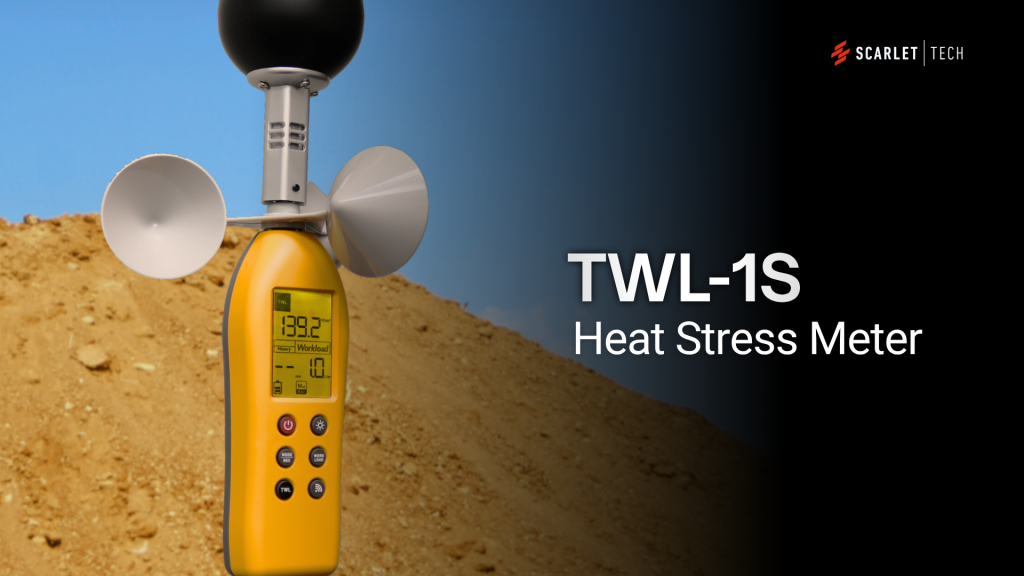
For HSE professionals, this can make TWL particularly useful for operational decisions where the question is not merely “How hot is it?” but also:
What level of work can reasonably be sustained under these conditions?
The study’s authors specifically concluded that TWL provides a novel approach for controlling workplace heat-stress exposure in settings where workers are sufficiently trained and are able to self-pace.
Why Air Movement Matters
One practical advantage of a heat-balance approach is its ability to account for factors that directly affect the body’s capacity to dissipate heat.
Air movement, for example, can substantially influence convective and evaporative heat loss. Two worksites with similar air temperature and humidity may therefore present different heat-balance conditions when wind speed differs.
This is particularly relevant for outdoor industries such as:
- construction,
- oil and gas,
- mining,
- utilities,
- ports and logistics, and
- infrastructure projects.
Measuring the complete thermal environment allows heat-stress assessment to reflect actual site conditions more closely rather than relying on air temperature alone.
From Heat Measurement to Worksite Decisions
The practical value of TWL is that the result can be connected to work management.
Instead of providing only an environmental index number, TWL gives HSE teams an estimate of the metabolic work rate that can be sustained under the measured conditions.
That information can support decisions involving:
- work intensity,
- work/rest planning,
- worker self-pacing,
- hydration,
- acclimatization,
- clothing and PPE considerations, and
- escalation of heat-stress controls.
TWL should nevertheless be used as part of a broader heat-stress management program rather than as a standalone guarantee of worker safety. Individual susceptibility, health status, acclimatization, hydration, clothing, workload and rapidly changing environmental conditions all remain relevant.
What Does the Research Tell Us?
The 2022 evaluation provides a more nuanced—and more useful—understanding of Thermal Work Limit.
The key findings are:
- TWL demonstrated high sensitivity, approximately 95–97%, for identifying uncompensable heat-stress exposures in the experimental dataset.
- TWL provides an operationally useful way of translating environmental heat conditions into an estimated sustainable work rate.
- TWL is less restrictive than traditional WBGT occupational exposure limits and should therefore not be interpreted as a zero-risk threshold.
- TWL is particularly suited to heat-management systems where trained workers can adjust or self-pace their work according to environmental conditions.
For workplace heat-stress management, the lesson is not necessarily to choose TWL instead of WBGT.
A more practical approach is to understand what each method provides.
WBGT remains an important and widely established method for occupational heat-stress assessment. TWL adds another layer of information by answering a highly practical question:
Given the environment right now, how much work can the conditions support?
For HSE teams managing workers in demanding hot environments, that is information that can be translated directly into action.
Reference
- Bernard TE, Ashley CD, Kapanowski D. Ability of Thermal Work Limit (TWL) to Assess Sustainable Heat Stress Exposures. Annals of Work Exposures and Health. 2022;66(8):1081–1085. doi:10.1093/annweh/wxac029.